
 English
 中文简体
中文简体 Español
SPC vs Engineered Hardwood: Which Handles Moisture and Daily Wear Better?
A distributor in Dublin called OSK after an engineered hardwood order started cupping around the perimeter. The slab read 4.6% moisture on a moisture meter, and the supplier had already spent nine days acclimating the boards. The SPC planks in the same building, installed on the identical slab, have stayed flat through fourteen months of daily traffic. When a project includes bathrooms, basements, or high-footfall commercial zones, stone plastic composite is the material worth specifying.
What SPC Flooring Is Built From
SPC (stone plastic composite) is a rigid core plank made by mixing limestone powder, PVC resin, and a stabiliser blend, then extruding the mix into a dense core. That core is why an SPC floor stays dimensionally stable when it gets wet.
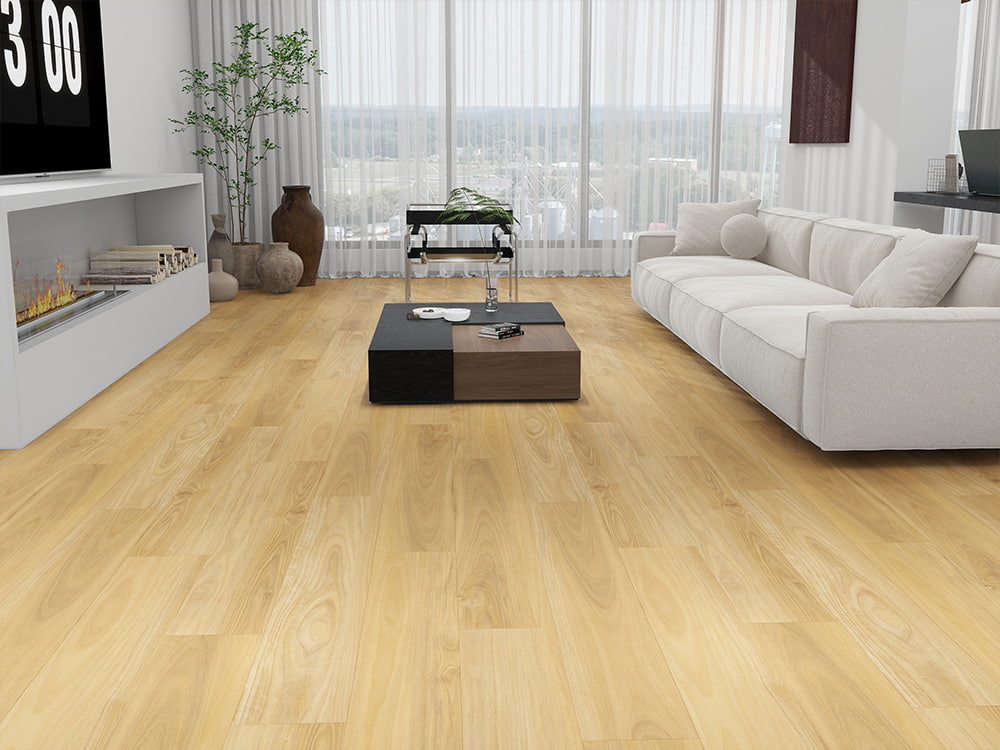 Stone Plastic Composite Flooring by OSKOSK manufactures SPC flooring with a rigid core of limestone and PVC, pressing four layers into a sealed unit for dimensional stability and water resistance, backed by their own testing lab and international standards.View Product →
OSK's manufacturing line presses four distinct layers together at once, so the plank behaves as a single sealed unit rather than separate stacked sheets.
- UV-cured wear layer - 0.3mm for residential, 0.7mm for commercial traffic
- Printed decor film - reproduces natural wood grain or stone without the sensitivity of real wood
- SPC core - the stone-polymer backbone that stops swelling
- IXPE or EVA underlayment - absorbs footfall sound without adding moisture risk
Because the core is limestone-based, OSK's SPC range does not need the 21-day acclimation period a hardwood floor demands. It can be installed over slabs with readings up to 75% RH as long as a vapour barrier is used.
Engineered Hardwood's Moisture Thresholds
Engineered hardwood will absorb water. Most plywood-backed engineered floors record 6% to 12% water absorption in standard testing, and the layers can swell unevenly, producing visible cupping within weeks.
- Cupping - plank edges lift above the centre
- Crowning - the centre swells above the edges
- Veneer delamination - the adhesive bond fails between layers
- Finish deterioration - water breaks down the polyurethane coating
The same failure mode shows up in many commercial spaces served by OSK, where slip and moisture risk are the first questions a buyer asks.
Daily Wear: The Wear Layer Decides
The wear layer is the real durability lever. SPC planks carry a UV-cured polyurethane wear layer of 0.3mm to 0.7mm. Engineered hardwood uses a factory-applied finish that is only 0.05mm to 0.1mm thick. The difference shows when a dog runs across a living room or a trolley crosses a commercial lobby.
OSK's published research on SPC durability and waterproofness explains this edge in detail. A 0.7mm commercial wear layer absorbs constant abrasion from rolling carts and dropped tools without showing indentations, while engineered hardwood lets water break down the finish.
Side-by-Side Comparison Table
These are the numbers OSK tests in its own quality lab before any container leaves Zhejiang.
| Attribute | SPC Rigid Core | Engineered Hardwood |
| Water absorption | 0.3% - 0.5% | 6% - 12% |
| Wear layer | 0.3mm - 0.7mm | 0.05mm - 0.1mm |
| Scratch resistance | High | Medium |
| Refinishing | Not needed | 1 - 3 cycles |
| Bathroom and basement use | Yes | Not recommended |
| High-moisture slab install | Yes | Requires treatment |
| Price per square metre | $12 - $25 | $30 - $60 |
Real Cost Over a 15-Year Window
Initial price is only the first line item. SPC costs less per square metre, needs no refinishing, and does not require moisture barriers or long acclimation. Engineered hardwood costs more, and a full sand-and-refinish cycle adds $25 to $40 per square metre every 7 to 10 years.
- SPC - one-time installation cost, zero refinishing, 15-25 year warranty
- Engineered hardwood - higher purchase price, moisture barrier expense, 2 refinish cycles, potential board replacement
When Engineered Hardwood Is the Right Choice
In a climate-controlled bedroom with no pets and no water source, engineered hardwood delivers a natural wood grain that printed SPC film cannot fully replicate. If the project prioritises authentic wood over resilience, that trade makes sense.
Frequently Asked Questions
Can SPC flooring be installed directly on concrete with high moisture?
Yes. SPC's water absorption is below 0.5%, so it can be floated or glued over slabs that measure up to 4.5% moisture content. OSK recommends checking slab RH before installation; readings above 75% RH call for a vapour barrier regardless of the flooring.
Does SPC scratch as easily as engineered hardwood?
No. The UV-cured wear layer at 0.5mm is five to ten times thicker than the finish on an engineered hardwood plank. Pet claws, high heels, and castor wheels leave the decor film on SPC intact, while the same traffic can expose the veneer on engineered hardwood within the first year.
Can you use SPC in bathrooms and basements?
Yes. The limestone-polymer core does not expand or delaminate when wet, so SPC is commonly installed in bathrooms, laundry rooms, and below-grade basements. Engineered hardwood is not recommended in any below-grade space because it can absorb water through the plywood backing.
How long does SPC last compared to engineered hardwood?
SPC carries a 15-25 year residential warranty. Engineered hardwood can be refinished up to three times, extending service life to 25-30 years in ideal conditions, but each cycle adds cost and downtime. In real-world projects, SPC is more likely to reach its full service life without major intervention.

